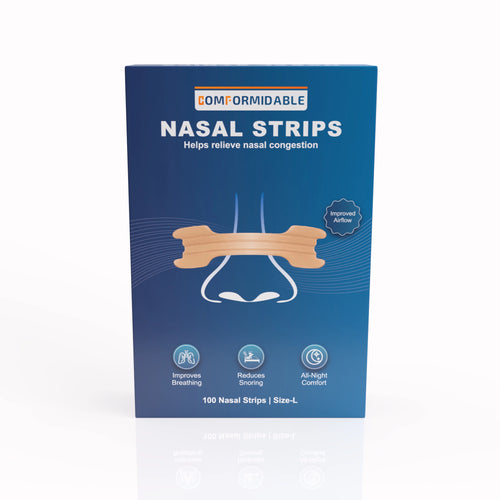
Nasal strips are more popular than ever. Whether you use them to breathe better during sport, snore less or simply breathe a bit more freely through your nose, the market is full of them. But how do you know which strips are truly safe for your skin? And which brand can you really trust?
We take that question seriously. That's why we had the Comformidable Nasal Strips independently tested by Dermatest®, one of the most renowned dermatological testing institutes in Europe.
The result? Rated "very good", without a single skin reaction in all 30 test subjects.
What really makes a nasal strip the best choice?
If you're looking for the best nasal strips, you're probably comparing on price, width, adhesive strength or brand recognition. What's often overlooked is skin safety.
Nasal strips go directly on your skin. Specifically on the sensitive skin around your nose. That skin is in direct contact with the adhesive layer and with the material of the strip itself. Cheap or poorly formulated strips can cause skin irritation, redness or even allergic reactions. Especially with daily use, that's a real risk.
What you actually want to know before you buy: has this product been independently tested for skin safety?
Dermatologically tested: what does that actually mean?
Not every product that claims to be "dermatologically tested" has the same evidence behind it. For the Comformidable nasal strips, an official epicutaneous test was carried out, better known as a patch test, following international guidelines including DIN EN ISO 10993-23:2021 and recommendations from the DDG, DGAKI and Colipa.
How does such a test work? Small pieces of the product are applied occlusively to the skin of 30 test subjects with various skin types for 24 hours. A dermatologist then assesses the skin after 24, 48 and 72 hours for any reactions.
The assessment scale runs from 0, no reaction, to 3, a strong reaction with swelling or crusting.
With the Comformidable nasal strips, all 30 test subjects scored a perfect 0 at every measurement point. Both for the top of the strip and for the adhesive side.
That's not a marketing claim. That's science.
Two components tested, twice approved
The Comformidable nasal strips are what's known as a multi-component product. Both the top, the visible material, and the adhesive side that rests on your skin were tested separately. Both passed the test without any skin reaction.
This matters because with many nasal strips, it's precisely the adhesive layer that causes skin problems. Cheap adhesives can lead to redness, flaking or small skin lesions with repeated use. For the Comformidable strips, it has been scientifically demonstrated that this risk is not present.
View the official Dermatest® certificate here
What does the Dermatest report say?
The study with study number ST-ET-2026-00050 was carried out from 23 to 26 March 2026 by Dermatest GmbH in Münster, under the supervision of dermatologist Dr. med. Werner Voss, specialist in dermatology, allergology and environmental medicine.
The specialist conclusion from the official report:
From a dermatological point of view, the product shows no high irritation potential and, when used as intended, will not lead to undesirable skin reactions.
That's exactly what you want to know if you stick a strip on your nose every day.
Who are the Comformidable nasal strips suitable for?
Thanks to the broad test panel of 30 subjects aged between 19 and 75, with various skin types from dry to oily, normal to sensitive, male and female, the strips have been shown to be suitable for a large group of people.
Whether you're a teenager who struggles with a blocked nose while sleeping, or over sixty and wanting to breathe a little better at night, the skin safety has been scientifically confirmed for your skin type.
Why this makes the difference when buying nasal strips
The market for nasal strips is large and hard to navigate. Many products are sold without any independent testing for skin safety. Nice packaging or a low price says nothing about what happens to your skin with long-term use.
The Dermatest® Guarantee Seal and the Skin-Friendly Material Seal awarded to the Comformidable nasal strips are not symbols you can simply buy. They are only awarded when a product passes the independent test and fewer than 10% of test subjects show a skin reaction.
For the Comformidable strips, that percentage was 0%.
Ready to try the best nasal strips?
If you want to buy the best nasal strips, based not just on gut feeling but on evidence, you now know what to choose.
Browse the Comformidable nasal strips
Scientifically tested. Dermatologically approved. Ready to use.
Study number: ST-ET-2026-00050 | Test period: March 2026 | Testing institute: Dermatest GmbH, Münster
Frequently asked questions
Which size nasal strips do I need?
The standard Comformidable nasal strips are size L and measure 66 x 19 mm, suitable for most adult noses. The pink variant is size M (55 x 16 mm) for smaller noses and the black round strips measure 60 x 23 mm.
Are nasal strips a medical device?
Yes. Nasal strips against snoring are class I medical devices under the European MDR regulation 2017/745. The Comformidable nasal strips are registered in EUDAMED and dermatologically tested by Dermatest (certificate ST-ET-2026-00050).
How often can you use a nasal strip?
A nasal strip is single-use. Use a new strip every night for the best adhesion and hygiene.
Do nasal strips also work with a cold or hay fever?
Yes. Nasal strips open the nostrils mechanically, without medication. That's why they also help with a blocked nose caused by a cold or hay fever.
How much do nasal strips cost per strip?
The Comformidable nasal strips with 100 strips are a value pack: per strip you pay clearly less than with single brand-name strips. Order several packs at once and you automatically get a bundle discount, lowering the price per strip even further. You will find the current price on the product page.